Saturday, August 4, 2012

Holes. And also .gifs.

I've been thinking about holes. Not the kind you dig, but the kind that are dug into you. And I've been thinking about the things with which we fill those holes.


Before you facepalm and click away, no, that is not a euphemism. I mean, yes, it very easily could be, but I don't mean it in that sense – or, at least, not exclusively in that sense.


People are filled up with holes. Whatever fragile fabric makes our souls is riddled with gaps, some of which we rend ourselves, but many of which, I think, are created by others, by society, by forgotten dreams and unfulfilled expectations.


I spent almost a month back home this summer, and since I've been back in my apartment, I've spent a disproportionate amount of my time hugging my cats and feeling despondent and massively lonely. Part of that is that my parents are my best friends, and being two thousand miles away from them is really hard. Part of it is that living in a house with others is a very different thing from living alone, and readjusting is painful as always.


But being lonely made me think about being lonely, and how many of us are lonely so much of the time. Even when we're around other people, even when we're laughing and sharing with friends, we seem to be battling this crippling isolationism.

I think romantic isolation is one of the primary ways people in our age group are made to feel inadequate. We are conditioned all our lives to believe that once we reach our mid-twenties, we're supposed to be involved in a stable relationship that will, in all – however unspoken – likelihood, lead to marriage. Just like we're conditioned to believe in one standard of beauty, and one kind of traits to find attractive, we're conditioned to believe that we are incomplete and in general less than if we are not romantically involved.


We feel lonely, too, because we are constantly comparing ourselves to everyone around us. Having spent the last two and a half months unemployed and acutely aware of that fact, I learned precisely how degrading it can feel to be out of work, despite having a degree and a passably decent skill set. The inadequacy can be overwhelming; it attacks you in your very soul, to the point where you are tired in your bones and the color starts to bleed out of the world with every new rejection.


We feel lonely despite being massively interconnected. The fact that I can text any of fifty different people right now, or am on Tumblr with thousands, or have Facebook open on another tab, where I am hooked to 200+ "friends," does not alleviate the fact that my house feels dreadfully empty. The astonishing myriad webs between us all does not fill the holes inside our spirits: They just fool us into thinking we are full.


But none of those things are true. Not really. The moments that restore us, in my experience, do not come from screens or sex or substances. They come from moments where we are known. Really known, and recognized not as someone we present to the world, but as really what we are, flaws and foibles included.


Sometimes, the holes inside us are raw and jagged, and they pester, and they stress, and they pick at us. But we cannot fill an emptiness with empty things. It makes sense that in a society that rejects us for the slightest transgression, we would be frightened of rejection and therefore play the judge in our own exiles. Perhaps bred within us all is a fear of the truth, a fear of being rendered naked and having our imperfect minds and bodies bared to another living soul.


My dad had this saying when I was growing up, about how relationships work. I'm doubtful as to whether he said it first, or was quoting some half-remembered source, but he said, "Seek first to know, then to be known." He said that was the key to not just his marriage, but all successful relationships between humans.


Long before my dad and I ever spoke about relationships, Aristotle wrote in his Metaphysics, "All men by nature desire to know...the human race lives also by art and reasonings. And from memory experience is produced in men; for many memories of the same thing produce finally the capacity for a single experience. Experience seems to be very similar to science and art, but really science and art come to men through experience; for 'experience made art,' as Polus says, 'but inexperience luck.' And art raises, And art arises, when from many notions gained by experience one universal judgement about similar objects is produced."


Aristotle continues to talk about how we generally consider great artists to be overall wiser than average people, because they understand not just things, but also the causes and purposes of things. Aristotle suggests that it's not their understandings we are admiring, but their experiences, because art is created by artists' representations of shared human experiences.


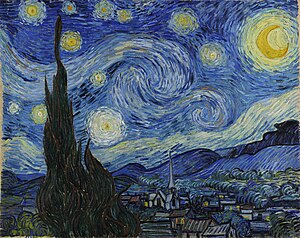
Experiences like loneliness. I can't think of one great artist, author or musician who created something brilliant out of a wellspring of joy. Typically, we are driven to inspiration and creation by trials and pain, by tears we cannot begin to understand. I think it's one of the most beautiful things about being human: that we are capable of transforming pain and tribulation into masterpiece. That a feeling as useless and bitter as isolation can make "Starry Night" or Wuthering Heights or all of Warren Zevon's discography is truly a remarkable thing.


http://upload.wikimedia.org/wikipedia/commons/thumb/e/ea/Van_Gogh_-_Starry_Night_-_Google_Art_Project.jpg/300px-Van_Gogh_-_Starry_Night_-_Google_Art_Project.jpg


Art moves us because it reminds us that we are not alone. The things we feel have been felt before; are still felt, all around us, constantly, perpetually, because we all feel somehow lonely and unrecognized. The isolation that both cripples and shelters us, the things that make us feel different and alone, are also the things that bind us all together and make us the same.


A wise friend once told me, "People are just people." Everyone has the same types of holes bored into them: holes of inadequacy, holes of fear, holes of obligation, holes of expectation, holes of isolation. And we all try to fill them with the same things: drink, sex, work, sleep.


I don't think the holes go away. Maybe we work hard, maybe we share an evening with someone who really gets us, maybe we pray, maybe we read or see something that reaches deep inside and pieces back together something that was broken, maybe we find real, ageless love, and maybe that fixes us in some way – and maybe then we trip into a new hole we hadn't registered before. I think part of being human is being full of holes, because if we weren't, nothing would ever grab us from the inside and stir everything up, and there would be no art or music or philosophy, because it is the tension between the way things are and the way we think they should be that shapes the world we live in.


-A

Sunday, June 17, 2012

It's supposed to be titled, "Final Fantasy and the American Dream." It was late, I was tired.

Tuesday, January 24, 2012

Wednesday, September 7, 2011

The NOLA Chronicles - Chapter Two

Vlog number two. <3 you all.

Wednesday, August 31, 2011

The Nola Chronicles - Chapter One

One of my friends from Institute began a video blog to record her first year of teaching, and I recognized that, though I would love to keep writing in The Apple Tree, I have very little time to do so; thus, a vlog would be the best alternative route. In the future, I'll try to embed videos directly into The Apple Tree, but this time, something nonsensical occurred in the formatting, so it's hosted by Youtube. Here's the link: 


Much love, 

A. 
_________________________
Failure is impossible. Defeat is not an option.

Monday, June 20, 2011

The Metamorphosis

Teaching, to me, is like putting on a new leather glove: it fits, but I’ll be damned if there’s not some stretching and creaking required to make it comfortable.

I lost my first name a week ago. ...No, not lost: abdicated. I am now called “Ms. Manly” more often than I am called “Avalon,” by my colleagues, my partners, my superiors and my students. I have to call home just to hear the moniker that was mine for 22 years. “Ms. Manly” is a title so professional and untested that it seems distant from everything I actually am; it’s like a scrape that hasn’t scabbed, jarred against every shifting breeze, forcing me to be aware of it at every turn.

When I sit in the cafeteria, monitoring breakfast or lunch, it always takes me a moment to remember that the “Teachers!” summons from the loudspeaker indicates me. I also have to remember not to flinch like a guilty teenager when the disciplinarian addresses the hall sternly, because I'm not a student anymore; I'm faculty. 

I wear a suit every day now. One of my students asked me last week, “Ms. Manly, you always wear a suit? You sure do own a lotta suits.”

This is the same student who thinks it’s an abject travesty that I don’t own a TV, and that my having weekends is the most startling thing since the toaster oven.

I’m not sure why toaster ovens are startling. I think, when I was young, I was startled by a toaster oven, and now assume that the rest of the world found them as off-putting as I once did.

It’s bizarre to have this much automatic authority. It feels almost inorganic; just because I have a nametag, I suddenly have all the answers, know what to do in any given circumstance, am shepherd to a flock of young minds. It's daunting, to say the least. 

I’m blessed and cursed by a classroom full of good kids - well, “full” is a subjective term, as my class is five strong this summer. I’m blessed because I can focus on the material, on molding how I teach to how they learn; I’m cursed because I am not obligated to practice unyielding management with them, and so I don’t. If my students in Algiers are more or unwieldy, I will almost certainly face struggles with correct behavior. The TFA motto is “100 percent compliance from 100 percent of the students 100 percent of the time.”

Crazy, right? But that’s the kinda thing we’re working on here. 100 percent mastery of 100 percent of the objectives by 100 percent of the students. And so forth.

Part of me - the perpetually disgruntled angel-headed hipster, the fiery but disquieted revolutionary - feels blatantly indoctrinated. That part of me yells and screams and scratches and snarls against the bars of the program, warning me darkly not to drink the Kool-Aid, to keep my eyes open and my mouth shut and my mind narrowed to a filter.

At first, I thought that was a problem. I thought that resisting the TFA philosophy was a sign of exactly how much I didn’t belong here, exactly how wrong TFA was to accept me. I worried that “the other shoe,” the “I’m sorry, honey, you’re in the wrong line, the janitors’ sessions are over here,” was going to drop at any moment, without warning or mercy.

But I was talking to my parents about it, and Dad reminded me that TFA selected me for a reason. Mom noted that they wanted who I was, not who they might try to make me into. Dad furthered that they hadn’t raised me to accept any philosophy without question or challenge, and that they’d be disappointed if that was how I chose to behave as a TFA corps member.

I’m still struggling to reconcile my philosophical departure from TFA’s mission with my earnestness to make a difference in this place. I think, honestly - and Jess and Matt will appreciate this - that I’m also struggling to act as part of a team. I’ve never been competitive at anything that involved other people. I was that kid who hated group work because I was the one who did everything; I grew up resigned to that fact. I’ve never been on a team, except maybe that one time in middle school, and I don’t think that counts because it was a trivia competition and, as such, short-lived.

Here, though, I’m on a few different teams. First, I’m on TFA’s team. I know that they’ve invested in me, and are available at every turn if I need help or answers or support. That’s sort of abstract, though, because that’s 38,000 people strong and nation-wide. On a smaller scale, I’m a member of the 2011 Atlanta Institute. There are 650 of us here this summer, all facing the same stressors, early mornings, crappy food and incredible workload. We have a FB group dedicated to sharing successes and struggles, requests for computer power cords and rides to the store, and what poor life choices we may make as a group this coming weekend.

On an even smaller scale, I’m a member of the GNO ’11 Corps. There are 183 of us - fewer, now, I think, as some of us dropped out along the way. I will be working with this group for the next two years. I’ve met perhaps 30 of us, but I like the vast majority, and have become close with a few.

Even more magnified, I am a part of the Kennedy/Brown (“Best in town!” as we shout at lunch) Middle School team. There are 48 of us here, new teachers all, overseen by a small group of alumni and staff.  In this larger group, I am part of a team of four, Collab 1099 (which sounds like a prototype Terminator, I know), with whom I spend most of my time now. In that team is my co-teacher, Landry, who, it seems, I speak with more frequently than any other human on God’s green Earth. My collab is remarkable. For the first time in my life, I am relying on others in work that affects me greatly, as they rely on me; in our larger Kennedy/Brown team, I share a vision and a learning curve with nearly 50 individuals, as part of a collective. It’s a weird and alien experience to work as part of a team toward a common goal. It’s foreign to sense my independence as an asset rather than a necessity.

I’ve also discovered that (*gasp!*) I’m an introvert. I love people, I do. But after I hit my dorm at 5 in the afternoon, I don’t want to see another living, breathing soul until 6 the next morning, when I hit the breakfast hall. My time alone, sometimes talking with my parents or beau, is what energizes me and gives me the confidence and capability I need to finish writing my lesson plans and stand up the next morning and teach.

I’ve spent three weeks now in what is essentially teacher boot camp. Our identities have been removed; the places from whence we hail made immaterial; the regions and subjects to which we are assigned our most critical identifiers; our personal freedoms, space, schedules and, especially, sleep, have been invaded and made to conform to a deprived model; our daily garb exchanged for the uniform of the professional; the daily workload expanded by exponential degrees until I do more now in one afternoon than I did in a month of college; our individual rituals and processes subverted in favor of a group whole. I’m stressed, and exhausted, and full of frustrated questions, and my brain isn’t working as well as it did a month ago because I’m not sleeping as much as my body requires, and my patience levels are down and my irrational emotional reaction levels are up and I know I’m not giving my best, because if I gave my best it’d be all I had to give and I’d have nothing to come back with tomorrow.

My partner, Landry, told me a quote last week from former SNL comedian Tina Fey: “You don’t go on at 11:30 because you’re ready. You go on at 11:30 because it’s 11:30.” That’s been my mantra this week. I don’t call my lesson plans done because they’re perfect and I’m ready; I call them done because it’s midnight and I have to get up in five hours and teach that plan, ready or not.

At the end of the day, it comes down to this: I have students to teach, and I’ll be damned if every single one of them isn’t going to pass their determining exam in two and a half weeks and go on to high school. My stressors and philosophical conundrums matter naught in comparison to that reality - hell, until my students know the word “conundrum,” I have no room to complain. Like our curriculum specialist says, “They’re teaching you to to be a soldier in the middle of a war.”

But I think I’m doing well. I’ve been given no reason, by my students, colleagues or superiors, to believe otherwise. I have miles to go before I sleep, but I think I can cover some ground before it gets too dark to see.

A. 
____________________________
Peace to this young warrior, without the sound of guns.

Thursday, May 19, 2011

Memoirs of an Undergrad.

There's a streetlamp at the end of my street. It waits there, tall and black and still, for me to turn the corner, to see it there, sentinel, etched against the darkening sky. I don't think I ever really saw it before late March, when I returned from a brief stint in New Orleans, where such street lights line every avenue and alleyway, as they have for 150 years now. 

Colorado has mountains; New Orleans has streetlamps. Both are iconic, both are lovely, both trace against the skyline as it purples into dusk. Each day, as the sun sets, now, I stare at the sun as it swivels on its daily arc to rest behind the mountains, and I tear up, just a little, as I realize that I'm one day closer to my last day in the Springs. One day closer to my last day at home, and my first day in my new home. I'm not sure how long I'll be away - at least two years. I don't know if Louisiana will become my home, as Colorado is now, and has been for more than 20 years, but whatever happens, I know I'll miss my mountains, and that my heart will ache for the open sky. At least it's windy there. At least there's that. 

***
Tomorrow morning, I'll be a college graduate, and the school part of my life - at least for now - will be over. That chapter is ended, to make way for another. 

As chapters go, it's been a very good one. Some things, though, remain unsaid. 

When musicians release albums, or authors, books, they are allowed a section of acknowledgements, and a dedication, an ode to those others who facilitated its becoming. 

Seeing as how without a select group of people, I would be not where I am now but somewhere else entirely, less rich and without promise, I owe a dedication, for every ounce of loving support and every piece of advise that got me through, for every line of unveiled honesty and driving query, for every moment of peace and safety and steadfastness I ever had. 

My success, then, my impending career, my abilities and character and philosophical standing, are owed to these:

To my parents, who were sometimes necessarily stern, but always loving, supporting and peaceful - who taught me everything I know about the human heart and the philosophy inherent in dishwashing - who provided for me all these years a home of joy and harmony in the face of a world that didn't know up from down - who never, once, even suspected that I might fail at anything about which I was sufficiently passionate - I dedicate all my successes, academic, personal, spiritual, intellectual and creative, for without them, none of that would have been possible. 

To my brother, who first showed me devotion, and then courage, I dedicate whatever ferocity I harbor, insofar as it is stemmed from love, because he loved me fiercely from the day I was born.

To my friend Jayme Swointek, whom I knew as Jayme Federick, I dedicate my stability, because it was she who taught me to be calm and to think broadly about the calamities that can befall any given moment. 

To my friend David Owens, with whom I passed a dozen lifetimes in a span of months, I dedicate my curiosity, for it was his prodigious mind that helped me learn to question, and his brilliant spirit that helped me find peace in the midst of the storm. With him, I watched the world change, and by him, my world was changed.

To my other brother, Slim, otherwise known as Merchant, I dedicate my loyalty, because it was he who showed me that relationships are not spawned out of necessity, but out of willingness and unquestioning faithfulness.

To my sister Heather, I dedicate my steadfastness, for it was her long-suffering heart that taught me about the permanence of faith, and the delight of fellowship.


To my friend Becca Brander, whom I knew as Becca Wolt, I dedicate my logic, because it was all those long nights of debate and discourse that built the foundation of my philosophical standing, with which I face each day.

To my friend Jessica Lynch, I dedicate my good humor, for all the times she made me laugh until I cried, and all the instances and circumstances made better by her presence. 

To my dear Matthew Crandall, I dedicate my potential, because it was he who helped me remember that, while the past might shape us, it does not define us - and it was he who showed me again the extent of my ability, when I had lost my way. 

There are, of course, others to whom I owe many thanks, including family, other friends and teachers who helped illuminate my path when it was shrouded and confused. I'm afraid, though, that I wax nostalgic, and you, dear reader, may weary of this tack. To you, who trace with your eyes and minds the makings of my hands, I dedicate my work, past, present and future, because it you who give my words meaning. Without you, they are simply symbols, lines of black upon a page, spent as soon as they are conceived. 

With you, they are me. So thank you, friends, dear ones, for reading, and for helping me along the way, each in your own specific ways, when I needed you most. You are blessings, and I look forward to the rest of my life, as it was made possible through you. 

A.
_________________
Let's see how far we've come.

Sunday, April 17, 2011

I am going to need God's own water purifier.

The water in the French Quarter tastes like well water and piss.

So, I guess Bear Grylls would like it, but for those of us who grew up downing water made almost completely of the purest, coldest snowmelt in the country, it's a massive, painful step down. It's such a step down that it's like falling off a ladder. Into a vat of stagnant pond scum.

The funny thing about water in New Orleans is that it's not all like that. The water in Carrolton tastes sort of metallic, but otherwise okay. The water in the Warehouse District (which is also, weirdly, the Arts District) tastes fine. So does the water in shops along the Riverwalk.

New Orleans gets all its water from two sources: the Mississippi River, which, thanks to my second grade teacher, I always spell in my head with a sing-songy rhythm to make sure it has all the right letters, and the Gulf of Mexico. Both of these sources, especially since the BP spill last summer, are muddy, distressingly sordid wastes of chemicals and filth.

My apartment is in Uptown. I have no idea how the water there tastes. I didn't think to try it out before I bought the place, which is probably a good thing, because paying rent from afar is hard enough without having to think about how nasty the water is, even though the place is a gorgeous and a freaking palace.

Growing up in the mountains has spoiled me. I'm such a hipster when it comes to water, now. Tap water from anywhere but here is just too mainstream. (...I apologize. That was a bad one, even as puns go.)

Therefore, I'm going to need to either (A) drink bottled water all the time, or (B) obtain the most hardcore purifier I can possibly get my hands on. Like, the purifier God hooked up to the river in Eden for the unicorns, rest their poached-into-extinction souls, to drink from.

It makes me feel sorry for all the poor souls that live and drink water at sea level. They don't get to eat snow, or drink straight from a mountain stream, contract giardia, almost die, recover and be thankfully immune so they can drink from mountain streams safely for the rest of their lives.

I was kind of a stupid seven-year-old.

Peace, A.
__________________________________________
So tell me now, where was my fault, in loving you with my whole heart?

Tuesday, March 8, 2011

How a small tidal wave ruined my life for two days.

A couple of weeks ago, I slipped and fell into a bathtub full of water.

Normally, this would not be a big deal to anything except my pride, and since no one but my cat was watching, I think I was safe on that one. But my abject, unrelenting gracelessness resulted in tragedy, due to the fact that I'm a little too ADD to even take a bubble bath without having something to distract my brain.

Let's step back and get a handle on the situation. I take an incredible amount of bubble baths. Enough so that I'm surprised I'm not permanently shriveled into a sad little old lady prune. No. Whatever number you're picturing, I take way more baths than that, every single week.

Some people collect rocks. Some, stamps. Some, useful, less depressing things, like maps, or types of forks, or something. Me? I collect books, and bath salts. I have a running set of bath soaps, salts, mixes, lathers and creams. My current favorite is a lilac salt mixed with a bubbling soap called "rainforest leaves," or some equally unhelpful, cryptic thing like that.

Anyway. When I take baths, I set up my little adorable Dell Netbook, Roland, on a chair beside the edge of the tub. I mix myself a drink (grapefruit juice and seltzer water - don't laugh, it's not as retarded as it sounds), turn off all the lights, start a movie and sink into this blissful, wonderful-smelling concoction of steaming water and soap.

Or, at least, I used to. A couple weeks ago, I had this arrangement all set up. "The Simpsons" was playing on my Netbook, and I was stepping into the tub.

Then I slipped, and the world ended in the resulting tidal wave.

It was like little Roland knew his time had come. Looking back, I can't remember whether the poor little guy shorted out before or after the water engulfed him. It is, in my mind, a moment frozen in time, with my mind screaming one long, uninterrupted, needlessly dramatic cry of negation as I fell. Then the wave hit, and Roland, in one bright white flash, went black. Right in the middle of this one kind of awesome commercial. (Now, whenever I hear Adrian Brody sing, a quick pain flits through my heart and, if I'm wearing a hat, I feel like taking it off in memory of the fallen.)

I tried to revive Roland for more than two hours. For all my frantic, well-meaning-but-mostly-useless-due-to-my-intense-lack-of-computer-savvy efforts, all I could manage was a horrible, staticy dying noise and some flashes of unblemished white. It was like The Poltergeist, except on my bathroom floor, and I wasn't haunted by anything but my own stunning failure.

The next day was a Tuesday. For you, that probably is just the day that follows Monday. For Avalons, it's the day when class goes on for eight and a half never-ending, uninterrupted hours. Have you ever tried to sit through an anthropology seminar that, instead of having a point, is just three hours of a biological anthropologist and a southwestern archaeologist talking somewhat creepily about how awesome they are? Yeah. I didn't think so. You need a computer to survive crap like that, so your brain has somewhere to go hide from all the BS.

But refuge was not to be had for my mind that day. I sat through eight and a half hours of class without any distractions. No Demotivational, no Failblog, no Penny Arcade. Just my brain and the professors' voices.

I took incredible notes. Two awful, actual attention-paying days later, I bought a new laptop, and caught up on my webcomics.

But then I started thinking about how heavily I rely on technology to get through every day. I take my computer everywhere (now, a luscious, brand-new MacBook Pro named Sidney, that cost almost as much as my car), and I text literally hundreds of times every day. I'd sooner go without my pants than my phone, and I'm pretty sure I flat-lined for a few minutes every couple of hours I went without a laptop.

I wonder what we'd all do if we suddenly had to actually talk with one another again.

__________________
I won't ever be a cornerstone.

Thursday, February 17, 2011

Sometimes I hate you, Logcial Avalon.

Two blog posts in one day. It's unprecedented, and might possibly be a sign of the impending apocalypse. When it starts raining fire, you can blame me. Or the president. I don't care.

I have this tendency to get incredibly involved in whatever I'm doing. I become so intensely absorbed that I forget about things that are conducive to an active, healthy lifestyle. Like eating. And moving. And drinking water.

Sometimes, I go from the time I wake up to the time I got to bed without eating anything, simply because I forget about food completely. I'll be hungry for, like, two minutes at a time, intermittently throughout the day, but forget about it so fast that I never get around to actually obtaining sustenance.

Yeah, yeah, yeah, I know it's not healthy. Shut up. That's not the point, and no one asked you, anyway. 

The point is, today was one of those days. I went 12 hours without food and forgot to drink water for, like, seven of those hours. Then I forgot to move for maybe three. I just sat in a chair, staring at a computer, working intently on designing this thing for this other thing. Let's not get into it. Suffice it to say I was staring at an iMac, listening to Eric Clapton, for a lot of hours, and I forgot completely about those basic everyday steps that keep humans, you know, alive.

When I reach a certain level of undernourished, dehydrated, frozen-in-carbonite 'tard, I begin having discussions with myself in my own brain. It's probably some small facet of my cerebellum pleading for help, appealing to the rest of my mind with every mite of its lingering ability.

These conversations go something like this. For the purpose of this entry, the voice of Logical Avalon will appear in bold; Idiot Avalon will retain normal typeface.

You need to print that page.
Oh, yeah. Printer's over there. Gotta get up. OH GOD MY LEGS. THEY HURT ME.
It's because you haven't moved from that position in three f***king hours, you moron. 
Right, right. Forgot about that.
I know. Get your shit together. It's time to go home. 
Yay! Overshirt, jacket, backpack...Looks like I have everything. Wait! Keys. Where are my keys?
In your backpack, dumbass. You put them there five hours ago. 
Ah! There they are. Alright, let's go home.
'Bout time. 
Wow. Staring at a computer screen for that long in a dark room really isn't conducive to navigating uneven terrain at night.
Your car's the other way. 
Oh, right.
Why won't it reverse?
E-brake. 
Ah, lol. Forgot.
I know. 
So cold.
It's because you're an idiot. Turn on the heat. 
Warmfasterwarmfasterwarmfaster
Turning now! Pay attention, Avalon. 
AHH! Oh, God, sorry! My bad.
Just...MERGEMERGEMERGEDON'THITTHATSUVOHGOD
OH SWEET JESUS nah, we're good.
Did you just forget how to merge?
Maybe.
*facepalm*
Shut up. You wanna drive?
YES.
...Well , you can't, because you're not real. You're just an imaginary representation of the deteriorating state of my executive functions.
The dashboard is squeaking. Why is the dashboard squeaking?
Maybe there's a gerbil trapped inside.
Please don't talk. This is our exit, you know. 
Oh, yeah. Thanks.
Just don't kill us. 
Stupid light. We always have to wait here. Why are the stoplights blurry tonight?
I think our vision is tracking.
Oh. Is that a good thing?
No. Almost certainly not. 
Why can't we see in straight lines?
Because you're an idiot and didn't drink water today. 
Ah. Gotcha. Turning, turning, turningturningturning
For the love of God, stop singing. 
Fine. You're no fun. Hey, this is our neighborhood! Almost home...
Finally. Jeez. Slow down, that might be a cop behind us. 
Nope. Not a cop. Just passed us.
Well, slow down anyway. You might hit a child that's wearing dark clothes. 
Would that be a bad thing?
Only in the sense that it would get us arrested. 
Laaaaaaaame. Yaaaaaaay! Home! Garage door, open sesame! 
Easy, easy OH GOD THOSE ARE STAIRS DON'T DRIVE THROUGH THEM THERE'S A FRIDGE THERE
BRAKES. There. Safe and sound inside.
Just...just get us inside. 
Whoo, a little dizzy. Standing is blurry.
It's because you're an idiot. 
We're swaying a little. Are we drunk?
I don't think we're drunk. 
Hm. That's odd.  Oh, well. What for dinner?
Just get liquid of some kind into our body and then eat something at least relatively nourishing. Please. For the sake of all that's holy. 
Alright, fine. Will you shut up for a while if I do?
Yes. 
Huzzah!

And now I'm eating saltines and milk and the logical part of my brain has shut off, for the time being.

And that was the story of how Avalon becomes so focused on tasks that her body goes into starvation mode and she forgets how to merge onto highways while driving. None of that was exaggerated, and no animals were harmed in the making of this production, except maybe for the dashboard gerbil.

_____________________
I'm gonna sing the doom song now.

Go Go Gadget Argyle!

I always thought that when I became a teacher, I'd be some different, grownup version of Avalon, not the normal, everyday Avalon of the present who eats fries with a fork, would rather read a book than go to a party and still wears pajamas all day if she can get away with it.

But nope. Turns out Ms. Manly is much the same person as Avy, just with more argyle and (hopefully) less tripping over cords publicly and fewer instances of laughing so hard that I cry and my mascara turns me into Avalon the Raccoon-Faced Girl.

In case you somehow hadn't heard,  I was offered a job as a corps member at Teach for America, a program that seeks to eliminate the inequities in public education by training teachers and placing them in high-need regions across the country.

Apparently, it's a competitive program. I knew it was tough, but I didn't know until last week just how tough: A Washington Post editorial from a couple days ago reads: "This year [Teach for America] got 48,000 applicants and accepted 5,300 of them. About 18 percent of the Harvard senior class applied; so did 27 percent of Spelman's, a traditionally black women's school."

As far as I know, only three of those accepted are from Colorado, though I could easily be mistaken. 

Honestly, I didn't really expect to get in. I was astonished when I received a welcome email. I signed a two-year contract with them and I'm still in shock. I don't think it'll hit me until I'm actually in New Orleans, where I've been assigned to teach high school literature, breathing the humidity and missing the mountains.

I wonder what it will be like to live in a big city in the South. The place where jazz was born. The bayou, the inspirational epicenter for artists like Anne Rice and whoever wrote True Blood.

I also wonder what it will be like to teach. I can't decide whether I'm more terrified, excited or intimidated. Some weird blend of all three, most likely. Terrexcitimated. Yeah, that. Maybe the terror will ebb some after I take my teaching license exams next month. *gulp*

I'm trying to augment my wardrobe so as to dress as if I'm 35, because I don't want my students to know I'm only four or five years older than they. I can't see that being a good thing in the best of circumstances, but as a first-year teacher in a strange city at an alien school? Hells no. So, I have some new blazers, and I really need to find me some sweater vests. Maybe some tweed patches. You know, because it'll help my credibility. 

Every time I do something, I wonder what it will be like to do that same thing in New Orleans. I wonder what gas will cost in New Orleans? I wonder what the sun feels like in New Orleans? I wonder how windy it gets in New Orleans? I wonder if I will find a coffee shop to call home in New Orleans? I wonder what the traffic is like in New Orleans? I wonder how the hell I'll find my way around New Orleans without mountains as a reference point?

I wonder what it will be like to run a classroom. I wonder if I'll be any good at it. We'll see, because that TFA contract is pretty much iron-clad and I'm in for the long haul, now.

For those of you who endured that scared little whiny rant-thing, here's some things that are awesome:

 (This is my wallpaper on my phone now.)


(It's awesome because it's a kitten.)


(This is a comic from cracked.com and I think the best way to ever answer the question, "How are you?" is by shouting the word, "AWARE," because no one ever actually cares how you are and it might brighten their day a little. Or at least startle them, and there's merit in that.)

That's...that's all I got. Here, have a really painful pun that's vaguely literary and involves a beaver:
________
Han shot first. 

Wednesday, December 8, 2010

The Four Kinds of People who Fail at Public Speaking

I am the queen of BS. 

I don't mean to be immodest -- no, wait. That's a lie. Let's not add deceit to my list of crimes.

In this instance, I mean to be perfectly immodest. The ability to pull a relevant, involved, well-structured, adequately-supported term paper out of the ether seven hours before it's due and still get four hours of uneasy sleep is the academic equivalent of Chuck Norris riding a unicorn over a double rainbow while showing you how to achieve a fully rounded abdominal workout for only three easy payments of $19.99. 

Likewise, the successful conception, creation and execution of a presentation  inside a matter of hours is a skill to be envied. Studies show that the top three fears of Americans are (1) public speaking, (2) spiders and (3) death. 

Public speaking is scary. Deep inside us, something snaps when we get up in front of a room of our peers and prepare to speak. We think that we'll trip, or stutter, or forget a point, or forget to zip our fly, and somehow, we'll end up naked, scorned and unprepared before an audience of thousands that includes the president, your mom and that guy you've liked since you were seven. We care so much about what other people think of us that even though every single other person in the room as just as scared of you as you are of them (which, incidentally, is the same argument commonly used against the fear of spiders, where it is equally ineffective and just as frustratingly useless), the jagged, electrified cloud of rejection looms over us during that long walk up to the podium-shaped gallows.

Unlike most people, I've always enjoyed public speaking. I get nervous, sure, but it's more the anticipation that looms in your gut before a roller coaster plummets toward the ground, rather than the crippling horror that you'll soon be fleeing an angry, heavily armed mob that you helped incite. Whatever fear I once held of the activity has been flayed out of me during my years as a communication major. (The flaying of the communications department, contrary to popular opinion, is not done with an overly soft pillow stuffed with down; it's actually a whip made of the dreams we comm. majors once held of making enough money to pay back our student loans or being qualified to work anywhere more prestigious or less greasy than McDonald's.)

Frankly, public speaking's not that hard. You're just having a really organized, overwhelmingly one-sided conversation with a room full of people, all of whom are listening to you without interruption. 

Okay, so it's nothing like a conversation. But, I think most people fail to realize that everyone in the room wants you to succeed. It's torture for everybody when a speaker stands up and completely bombs. When someone proceeds to fail in simply incredible ways in front of a group of their peers, it's like the room lets out a massive psychic groan, and everyone proceeds to zone out and wait for the pain to stop.

In the last couple of weeks, I've given maybe five speeches, none of which were terribly difficult. Some required more preparation that I'm usually willing to grant -- measured in days rather than hours or minutes -- but in that time, I've also witnessed a couple dozen presentations by my fellow students. Anyone who has ever had to endure the class periods consumed by group or individual term presentations feels my pain, and will recognize these brands of speakers:

1. The Dependent
These speakers are fairly certain that the world will immediately be consumed by baleful fire if they glance away from their notes for so much as a second. Of course, you don't know if their notes are actually a primeval text in the tongue of the Old Ones, only the active and uninterrupted reading of which is preserving all life and creation, because they are reading their notes to their notes. The paper is so close to their face that you can't possibly hear a word they say; hunched over like an abused puppy, trying to make themselves as small a target as possible for the deadly lasers that are surely hissing from your eyes, all you can grasp is a quiet, terrified mumbling.
   
2. The Freeze-Tag
These guys have been frozen in place by some malevolent villain. Despite the fact that the entire front of the room is open to them, their feet never move. Sometimes, they almost shift their weight, and everyone leans forward, waiting, hoping that maybe, just...maybe...they will free themselves from their invisible bonds and step forth, away from the computer, into the rest of the room. They gaze around like deer caught behind a fence -- and not just any deer. No, deer that specifically lack significant problem-solving capacities usually boasted by other deer. They're just...trapped. It makes you anxious just to watch them suffer.

3. The Smooth Operator
These guys get away with never doing work because they're relatively smooth to begin with. They're good at getting people to like them, and they count on that skill rather than research or preparation to create a successful presentation. They talk in circles, but never actually say anything, because they've got nothing to say. In groups, they don't do a damned thing; rather, they lean on everyone else, rephrasing their points or just sneaking in random transitions between topics to make you feel like they contributed. (Read: Politicians.)
   
4. The Rash
 Usually, these guys do just fine -- except that, as soon as they step in front of a class, they appear to be suffering from some awful, horrifying, debilitating disease. Their nervousness, refused access to the brain and unable to suddenly block access to thoughts and words, rebels and channels through the skin, creating weird, alien blotches of red all over their face, neck and hands. I always want to lean back in my chair, to get as far away from them as possible, because while their presentation might be fine, I'm terrified of catching some horrible plague that will eventually kill everyone I've ever known and loved.

This is to say nothing of the PowerPoints people create to "compliment" their speeches. It seems like there's no happy medium.

It's either, "Wait. There are not enough words in that bullet point to make me grasp the idea or event you are attempting to convey."

Or, "OH, MY GOD! IT'S A MONSTER WALL OF TEXT, WITH NO RELIEF IN SIGHT! SAVE US!"

To which, I reply: tl;dr.
Avalon, out.

PS - Spiders are legitimately terrifying, and this post should by no means be interpreted as a jibe against people who squeal like skewered baby pigs when an arachnid appears.

_______________________
"Did that dog just crap a bloody shoe?"

Friday, April 23, 2010

Selah.

On Meditation
A friend taught me a new word today. "Selah" is a word in Hebrew that can be translated as "stop and listen," or "pause and measure," and occurs seventy-one times in Psalms, or so says Wikipedia. It's important to ruminate, to digest and gestate, to learn the ideological ground upon which we stand. So I mentally masticate, and store the leavings here, to revisit, revise, retract and reiterate.


On Patriotism
My mother thinks that Johnny Depp's thoughts on America are distasteful, and he is for them sometimes difficult for her to watch. I agree with her so far as to view them as poor form, simply for his status as a public figure who's made a hell of a lot of money off America, but I also view it the same way I view the burning of the flag. Apart from the fact that it's just a piece of cloth, I understand its symbolic meaning and how important it is to some people and as the icon of this country. So I can sympathize when some people are enraged by its desecration, or by words like Depp's. At the same time, I realize that only a handful of other countries in the world would tolerate the burning of their flag without swift and violent retribution. I know that Congress has made valiant attempts to outlaw flag-burning, but it remains a protected act under the First Amendment. So, basically, because our country believes in freedom of expression, people are free within its borders to express themselves through the desecration of the flag...which is, in its own way, very beautiful. In the very moment of supreme protestation, the patriotism of such desecration is affirmed. Their act of expression became, in flames and ashes and distaste, an act of patriotic bent, because nowhere else in the world would such an inconsiderate destruction go unpunished - or, indeed, protected.


On Contradictions
I read a book called American Gods, by Neil Gaiman, the genius author of childhood nightmares and literary acid trips. American Gods is the story of the old gods, and what became of them in a world that refused to acknowledge them. It is a story full of myths and madness and McDonald's, and there isn't much I can say besides, "Good God, read this book," because it is made of sheer amazing, but there is a passage that stuck with me (page 393-5):
"Who did kill those men?" she asked.
"You wouldn't believe me if I told you."
"I would." She sounded angry now. He wondered if bringing wine to the dinner had been a wise idea. Life was certainly not a cabarnet right now.
"It's not easy to believe."
"I," she told him, "can believe anything. You have no idea what I can believe."
"Really?"
"I can believe things that are true and I can believe things that aren't true and I can believe things where nobody knows if they're true or not. I can believe in Santa Claus and the Easter Bunny and Marilyn Monroe and the Beatles and Elvis and Mister Ed. Listen - I believe that people are perfectible, that knowledge is infinite, that the world is run by secret banking cartels and is visited by aliens on a regular basis, nice ones that look like wrinkledy lemurs and bad ones who mutilate cattle and want out water and our women. I believe that the future sucks and I believe that the future rocks and I believe that one day White Buffalo Woman is going to come back and kick everyone's ass. I believe that all men are just overgrown boys with deep problems communicating and that the decline in good sex in America is coincident with the decline in drive-in movie theaters from state to state. I believe that all politicians are unprincipled crooks and I still believe that they are better than the alternative. I believe that California is going to sink into the sea when the big one comes, while Florida is going to dissolve into madness and alligators and toxic waste. I believe that antibacterial soap is destroying our resistance to dirt and disease so that one day we'll all be wiped out by the common cold like the Martians in War of the Worlds. I believe that the greatest poets of the last century were Edith Sitwell and Don marquis, that jade is dried dragon sperm, and that thousands of years ago in a former life I was a one-armed Siberian shaman. I believe that mankind's destiny lies in the stars. I believe that candy really did taste better when I was a kid, that it's aerodynamically impossible for a bumblebee to fly, that light is a wave and a particle, that there's a cat in a box somewhere who's alive and dead at the same time (although if they don't ever open the box to feed it it'll eventually just be two different kinds of dead), and that there are stars in the universe billions of years older than the universe itself. I believe in a personal god who cares about me and worries and oversees everything I do. I believe in an impersonal god who set the universe in motion and went of to hang with her girlfriends and doesn't even know that I'm alive. I believe in an empty and godless universe of casual chaos, background noise, and sheer blind luck. I believe that anyone who says that sex is overrated just hasn't done it properly. I believe that anyone who claims to know what's going on will lie about the little things too. I believe in absolute honesty and sensible social lies. I believe in a woman's right to choose, a baby's right to live, that while all human life is sacred there's nothing wrong with the death penalty if you can trust the legal system implicitly, and that no one but a moron would trust the legal system. I believe that life is a game, that life is a cruel joke, that life is what happens when you're alive and that you might was well lie back and enjoy it." She stopped, out of breath.
Shadow almost took his hands off the wheel to applaud. Instead he said, "Okay. So if I tell you what I've learned you won't think I'm a nut."
"Maybe," she said. "Try me."
I especially love the part about Schrödinger's cat. But, overall, the passage got me thinking: Humans are made of luscious contradictions. Conflicting definitions and beliefs and attributes and labels that will never be subdued to congruent understanding. I, for instance, am a journalist and an activist; a Christian and a pragmatist; a utilitarian and a humanist; a dreamer and a realist; a philosopher and an anthropologist; a lover of Truth and a "truther;" a lover of dance and a practitioner of reservation; a socialite who sometimes feels alone; a writer who is always up for a plot-less action movie; a comic-book reader who despises small print; a student of communication who texts 300 times a day and has trouble expressing feelings; an inked professional; an overweight proponent of the value of exercise; an oft-disliking adherent to the idea of pure love. We are all made up of conflicting criteria - which is, when you think about it, kind of ironic. Humans compartmentalize to survive. We create calenders and genus and strata and graphs and patterns to categorize and label and sort alphabetically. We like even numbers and major notes and straight lines arranged by size and color. Yet we, ourselves, defy such easy categorization. We defy ourselves. We deny the supernatural and yearn superheroes. We were made to love and yet are capable of incredible cruelty. We seek emaciation and drown in plenty. We work to support our families and don't work on our familial relationships. We believe in people but not in their Creator. We understand inequality, but ignore our spheres of influence. Our minds, made for neat shelves of information, are themselves a jumble of entropic chaos that germinates like tropical plants. It's beautiful and confusing and irritating and incomprehensible and sublime and maddening and exactly what being human is all about.

-Avalon

Light up the room.
Joe Henry


Friday, March 19, 2010

Project Sparks: Colton Taylor

(I apologize for the delayed post. Midterms ate my soul.)

The first signs that something was wrong occurred some time before the diagnosis. Colton's femur snapped from simple over-extension; he was desperately anemic; he frequently suffered fevers; and the lower section of his abdomen was becoming oddly distended and painful.

After a full gamut of tests, on Dec. 10, 2009, Colton was diagnosed with hepatoblastoma, a kind of liver cancer. Treatment began immediately, because the cancer was already aggressive - stage IV, in fact.

Next week, Colton begins his fifth round of chemotherapy. There is a scar on his side from the liver biopsy, and a bruised bulge over his heart, where the doctors installed a metal port to ease the administration of injections he must receive daily. If he is to survive, he must undergo several more methods of treatment and a liver transplant.

Colton Taylor is eighteen months old.


Jennifer and Scott Taylor have been married for six years. He is active duty National Guard; she works as a paramedic firefighter at Fort Carson. They tried for more than four years to have a child, and rejoiced when Jen became pregnant with Colton.

Colton was fifteen months old when he was diagnosed. The previously mentioned distention in his abdomen was a cancerous tumor so large that it had outgrown his bloodstream and begun to die in the center, causing an infection that overworked his white blood cells and resulted in anemia. Because cancer, as a rule, attacks rapidly dividing cells like marrow and hair, Colton's bones are very weak - which is why his leg was able to be broken during something as undemanding as play.

Hepatoblastoma is a rare cancer, usually only seen in children about Colton's age. Colorado Springs and Denver hospitals together hardly ever see more than two or so cases per year. At the time of his diagnosis, the cancer had already spread into his lungs, creating a collection of small tumors that are being shrunk to operable size with chemotherapy.

Soon, doctors will attempt to surgically remove those tumors. Should this operation prove successful, Colton will become eligible for a liver transplant.

"They don't even need a whole liver," Jen said with a small smile as she fed Colton yogurt with the ease of much practice, placing the spoon in his little mouth and sweeping its edge along his lip to remove the excess. It is possible that Jen herself will be able to donate a portion of her liver, which, once adopted into Colton's system, would grow along with him, though he would forever risk its rejection by his body. "He'll have to be on immunosuppressants for life," Jen explained.

Jen is tall, and spirals of long blond hair frame her face, on which rests a wide smile which belies the trial of her son's illness. There is a shadow, though, behind her eyes, at the corner of her countenance, a worry and a weariness, which she hides well. Perhaps it is her occupation - firehouses are notoriously closed hierarchical systems - or perhaps she is simply uncannily courageous - or maybe it's just the way in which she copes right now - or maybe it's that I still get worked up when I talk about the time when my mother had cancer, despite the fact that she's been well now for over half a decade. Whatever the reason, the blitheness and nonchalance of our conversation was almost unnerving. Had our conversation been observed on mute by someone else, we could have been talking of the weather. "I don't know anything else," she said at one point, referring to their struggle together. "He's our only kid."


Scott's emotions are less well concealed. His high-and-tight and mannerisms cry military life, but there is a storm in his eyes, a silent rage and a raw hurt at the sufferings of his firstborn. But the lines in his face were not always so deep; it was made for an easy smile that expresses a broad heart. I saw brief glimpses of that version of Scott only once or twice, when Colton's face scrunched comically in attempts to wink. Unlike Jen, Scott keeps each stage of Colton's treatment specific and cataloged in his mind, each as much a scar upon him as on his child.


The Taylors thank Heaven for the insurance Scott receives through his work for the National Guard: Colton's medical bills are being taken care of. Jen does worry, though, for his future. What if, she hypothesized, his body rejects the transplanted liver after he graduates college, when he'll no longer be covered by that insurance? How will he pay for the medicines he'll have to take throughout his entire life? Not to mention the problems they face a good deal sooner: the intentional suppression of Colton's immune system will decrease chances of organ rejection, but also eliminate possibilities like daycare or nurseries, where illnesses are likely to spread. "I just want him to be happy and grow up as healthy as possible," she said with an expression that explained that any problems after these, so early in her son's life, will be cake.

Colton is serving this year as a poster child for St. Baldrick's, as hosted by the firehouse for which Jen works. Today at 5:00 p.m., at CC's Armstrong Hall, a number of people will gather to shave their heads in solidarity with children who suffer from cancer. These soon-to-be-baldies garner financial sponsorship from their friends and loved ones, all of which is donated to research cures for childhood cancer. My sister-in-law, Jenn, and my brother, Adam, are both participants. It's not too late to participate in the cause.
Jen and Scott's needs are fairly met right now - they're grateful for the support of their friends and family, and, as always, for God's grace in their heartbreak and trial. They ask for nothing but prayer, and Colton's bright blue eyes and greenly flirtatious smile speak nothing but hope.


Thanks for listening.

Avalon.

"The monsters are real, but they're not in your dreams/ Learn what you can from the beasts you defeat,/ you’ll need it for some of the people you meet...Goodnight, Demon-Slayer, goodnight." -Voltaire

Saturday, February 20, 2010

When someone dies, you think about the past.

A year ago yesterday, my granddaddy died. Last night, I threw a small dinner party. Had some friends over, served some New Orleans-style food, as well as some ridiculously rich desserts. Toasted champagne. At first, I didn't think about why I was having the party on the 18th of February, besides the fact that my guests were free. But as the day wore on - as I shopped, and cleaned, and cooked, and set the table, and attempted (and failed) to handle raw meat - I thought more and more how Granddady would have liked that. That I was feeding people, inviting them into my home and my life and serving them fatty, Southern food and absurd desserts and laughing with them.

I wasn't hurting too bad yesterday. I'm hurting now. Thank God I can still remember his laugh. How he would get up every morning and make sausage and bacon and biscuits and grits and slice fruit so we'd have a vast breakfast awaiting when we awoke. How every meal was an extravagance to be shared and treasured. How food can be love, if dealt with in the right way - in the way he dealt with it. How he would stand in the kitchen with his apron on, leaning on the counter with a glass of red wine by his hand, laughing while he cooked. How amazing he was at crossword puzzles. How well he knew his God. How much love existed in his heart.

Granddaddy, I miss you. I love you. I hope to never forget.

-Avalon

Mannus hiec inimica tyrannus.

Saturday, January 30, 2010

Sparks

Everyone needs help sometimes. Everybody falls, and sometimes we fall hard. Sometimes we fall far. Sometimes we land broken and bleeding and, with tear-streaked faces, we barely dare to look to the sky, because sometimes, even hope hurts. Sometimes we can't imagine an upward slope even existing, let alone the effort required to ascend it. Sometimes it hurts to even breathe.

And in those times, our faith is shaken. Not just our religious faith - no, if only that! Our faith in the system; our faith in people; our faith in those who say that maybe, if we just helped each other, the world would be a better place.

When we fall, when we are shaken, when we rage helplessly against the chains of a world that seems indifferent or even overtly cruel - those are the times when we most need each other. On our knees, bleeding into the dirt, crying, alone in the dark - that is when we need a hand. Someone to stop by the wayside where we've stretched out to die, to reach out their hand, to look us in the eye, to speak with honesty and understanding and, above all, with love.

My mother always says that society, that the world, cannot change until people start truly helping one another. That the darkness has a foothold as long as we are indifferent to the needs of every other of us.

A friend told me last week that all human actions are selfish. Certainly, that argument can be made. But when we only help others because it makes us feel good, or to have a shot at scholarships, or to mark off hours required for a specific degree program, we do the right thing for the wrong reasons.

Altruism is the key. Until people do right because it is right, nothing is better. Sure, someone has a coat, or a meal, or whatever - and that's good. But nothing fundamental has changed. Nothing is fixed. Nothing is improved. Nothing is altered. It can take no more than a moment to change the world for the better - but it has to be exactly the right kind of moment, the right effort, for the right reasons, and on the right scale.

This is our world now, young ones. Our world. Our place. Our time. Our responsibility. We can choose to ignore it, or we can choose to take it back, to make it ours, to mold it according to our virtues, not our vices, and leave it a better place than it was when we arrived. Maybe. if enough of us share such heart, we can start a cultural revolution. Maybe, just maybe, we can improve not just the situations of individuals, but the minds of millions.

We all need help sometimes. We all fall, and we all need help to stand again. Maybe all it takes is a kind word, or a smile, or a gentle encouragement. Maybe it takes more than that. Maybe it takes some concrete alteration in circumstances. People need all different kinds of help when they hit the bottom. And there are all different kinds of bottom to hit. I don't know the answers. I don't have the map to a better world. I think I know what it takes - but I don't know what I'm prepared to give.

All I know is that I held a $258 pair of jeans last week, and was appalled. I was horrified that people could buy such things - such useless, frivolous, overpriced things! - while people in Tent City, not fifteen miles away, didn't have food, or a coat, while they live and sleep under the Colorado Street Bridge. Martin Luther King, Jr., said "Injustice anywhere is a threat to justice everywhere." He was right. Nothing can be right anywhere until it is right everywhere.

Then I realized that I'm a hypocrite. I drive a convertible, for God's sake. It's been eating me inside that I have so much luxury when others don't even have the bare necessities. I'm a selfish person, and I've been living a selfish life. I've been given much, and I might not have much in the material way to give, but I can give of myself. I can give my words. I can give my time. I can give my ear, and my pen.

It is time for me to start giving. God gave me the written word as my greatest strength, my most beloved power - so it is what I will give. Starting next week, I will find someone who has no other voice. I will hear their story, and I will record it here, along with their needs. These will not be people abstract in number or location. They will be people at home, in Colorado Springs, the center of my selfish indifference.

If you, dear, dear reader, wish to join with me in giving, listen to these stories. My words can do nothing alone in the ether; they do not exist until they are read. Stories are mere sounded air until someone hears them.

And sometimes all it takes is for someone to listen.

-Avalon.

Thursday, January 21, 2010

The Official Relocation

Welcome to my first official blog. I was weary of Facebook owning everything I posted and wrote, and here I can retain full rights to my words, so the move was an obvious one.

I can't promise that these blogs will contain anything more than long-winded musings on the world as I see it, and those only occasionally supported by evidence. I can't promise to write every day, or even every week - it's not so regularly that I have any thoughts I deem valuable enough to record for posterity. Or for the 1.5 people who read me. But for you, dear reader and a half, this is my new soapbox. Careful; just waxed it.

Thursday, October 8, 2009

For the ladies: a beautiful revelation.

Like unsweetened dark chocolate in the shape of a Midol pill and every one of Taj Mahal's live sets, this one is for the ladies. I know that some of you who innocently clicked on the update link, eager to read the latest Axioms of Avalon, are, in fact, male. I feel, in light of that fact, that I must provide due warning: If you are, in fact, male, you might not want to read what follows here. I, who am, in fact, female, write here about some things that I know apply mostly, if not entirely, to women. I'll be first in line in favor of gender equality, but I must concede to the fact that the genders are not actually the same. These differences are only a hindrance to gender equality if we allow them to be; but if we are to disallow them their negative stigmas in our world, they must be addressed. Indeed, some of them must be embraced.

So, dear men who read that which I write, men whom I love for all that you are and not an ounce more or different than that, tread carefully. Should you read on, you will find out more about women - or, at least, this woman - than I am almost certain you actually want to know, about a side of me I go to pains not to display. Maybe there is some insight in what is recorded here that is for you, but I think more likely not. In the following lines I will address women, as a woman, and on a level few, if any, men can understand. This is all I will say on the subject:

Guys, here there be dragons.

Ladies, I hope that the revelation I have experienced is translated accurately here. I hope that you find within it such significance as I did. As I do. I hope that you find it as wonderful and liberating and beautiful as I do. I know that some of you believe and feel differently from me: I hope that in spite of those differences, that you can understand and share in my joy. I'm done qualifying. Let's begin.

I've had less than my usual cause to speak of late. Partly, my new affinity for silence has to do with everything I've been thinking about, some of which I've recorded here. I'm becoming increasingly fascinated with people and the stories they tell, which means I talk less and less. Mostly, my newfound capacity for silence works in my favor, allowing me to listen to people, a pastime I am coming to adore more with each passing day. But in other circumstances, it's very difficult. It's difficult, for instance, when you're in a movie theater, waiting for the previews to start, sitting next to a great person of whom you would earnestly know more, whom you find fascinating, but who is also silent, when you can think of nothing at all to say because all you want to do is listen and absorb all they would say, but don't.

But my recent silences have been the soundscape to a profound philosophical journey, one still stolidly in progress. One I may never complete.

Journeys are difficult to encapsulate in words like this. I'm not sure where the start of the epiphany actually is. I guess...well, as good a place as any is with my ulterior motives for taking a Bible study class.

I've been in this course on Esther at my mom's church. I think I mentioned that last time. I signed on because the woman who wrote the study is famously generous with juicy historical tidbits, ancient cultural traditions, and foreign languages. In other words, I took it to learn. Should I feel my heart tugged a little closer to God's in the process, so much the better. But I wasn't really planning on it. (Don't worry, girls. I won't preach. This note isn't about that.)

Anyway. This study. It wasn't until the second or third session that I realized the subhead of the study is "It's tough being a woman." I mean, it's written on the cover of the workbook, but that's just me being generally unobservant. ...And not doing my homework in the workbook. Because I procrastinate. Lots. I'm, like, three weeks behind right now.

Each week's lesson is headed by a topic sentence based on the study's overall subhead. For instance, the first week's was: "It's tough being a woman in another woman's shadow." And it is, isn't it? We are constantly in unconscious or conscious competition with one another, for attention, for looks, for grace, constantly attempting to one-up each other rather than accept one another. In many situations - not all, I realize, perhaps not even most - we're small, mean creatures driven by our own insecurities and fears. It's hard to be outshown.

The next was "It's tough being a woman in a world where beauty is a treatment." In other words, where beauty is something you DO, not something you ARE. I had never thought of it that way before, but that is indeed the world in which we live, no? No matter what we do to make ourselves beautiful, how much time and effort and money we put into our appearance, we always feel like some other girl is more beautiful than we are. For every room in which two girls sit, there are two girls who feel that they are the ugliest one around. Face it, ladies. We live with the constant thought that we are inadequate, not enough, that any guy we meet can never think we're truly beautiful, that they're lying when they say they do. These irrational insecurities are bred into us, ingrained in us, viciously conditioned into our psyches, from day one.

I know, a weird focus for a Bible study, right? Moore, the study's author, said that there are four types of women:

1. The woman who wants everyone to think she's beautiful. She is a miserable woman.
2. The woman who wants all men to think she's beautiful. She is a dangerous woman.
3. The woman who wants none to think she's beautiful. She is a terrified woman.
4. The woman who hopes a few somebodies to think she's beautiful. She is the woman we all want to be, the woman who is secure, the woman who is thoroughly convinced that she is loved.

It is hard to exist in a world where we, as we are, will never be enough. We will never be pretty enough, thin enough, blond enough, charming enough, smart enough, good enough. Even the most beautiful woman we've ever see, who set our innards aflame with jealousy and our eyes aglow with admiration, is not enough. We are all in this weird little depressed boat of perceived inadequacy together, you see.

Ladies, do not misread me. I know that most of these acts and emotions are largely unconscious and culturally unavoidable. I am guiltier of them than most, I think. I know that we are not all petty, small, backbiting drama queens. But in all of us, there exists this consuming need to be more than we can ever possibly be, according to the standards of the world.

Our culture actively robs us of our dignity, of our integrity, modesty, purity. Again, don't jump ahead. I'm not going to sit here and shout puritanism or abstinence at you from some ivory tower. Screw abstinence. (Ha.) I mean the dignity, etc. of our souls. The pressure to be hot and riveting in all respects 24/7 is crushing and devouring. It absconds with the integrity present in security, the purity of being nothing but who we are, modesty in covering ourselves and knowing we are beautiful - for when we dress according to how the world dictates we should, all cold and cleavage, we are saying, in effect, "I agree with what you, the world, think of me. I agree that this is all I am worth." Not to say we shouldn't dress fun, or sexy, or whatever. Just, you know, those chick boxers? Those go under your pants. They don't actually count as pants in themselves.

So, with what are we left? We are inadequate, will never be unconditionally loved by our men, and are without even a reserve of dignity to call our own, having surrendered every ounce to the standards of the world. Here's where some of you may write me off.

We are left with all we ever had in the first place. We are left with God.

Allow me a tangent. Hugs are my pretty much my favorite thing. Studies show that humans need four hugs a day to survive; eight to achieve mental stability and twelve to incite psychological growth (NCBI, pubmed.gov). I certainly don't get that many - I don't think I know anyone that does. And, ladies, I know you'll agree with me on this one - nothing can relate to getting a great hug from a man, even if that man isn't your significant other. There is one man I know who gives the best freakin' hugs in the world. I think his embrace is so profound partially because his and my relationship is completely platonic, and I trust him explicitly. I could fall asleep in his arms, unashamed, without worry or miscommunication. But, on some level, that hug would still, somehow, fall short. It wouldn't be all a hug could be, even though his embrace is one of the greatest things I've ever known.

Tangent to a tangent, then wrap around to the point, I promise. They say that writer's write what they know. I agree, and would add that writer's cannot help but write what they know. A few nights ago, in one of those beautiful trances where I typed, eyes closed, the words I had not planned, to the story I, somehow, did not orchestrate, I wrote these lines. I hesitate to place it here, on the net, but when I read back what I'd written, it struck me, and I think it helps my point here:

"In the blink of an eye he swept me into an embrace, his arms tight around my back...His grip was strong and somehow desperate, as if he needed to be hugged as hugely as I did. When he did not slacken, I relaxed into that embrace, my head on his shoulder, free at last to confide the extent of my weakness, to be understood, to be protected, to be without fear. I wept onto his shoulder then, for some unknowable span of time. Perhaps it was just a moment; perhaps years passed us by in that clearing by the pool. Never did [his] arms slip from around me, and his breath was warm and sweet on my hair. The blessing of that moment, however long it actually was, is that I did not feel awkward. He hugged me tight, and I lost myself in his arms, not as a lover or a sister or a daughter, but simply as I was, with no role or expectation to uphold. It was pure, and it was all I had."


Doesn't that sound lovely? To be loved without expectation, without demand, to be, at last, enough?

Beth Moore wrote, "Christ is not ashamed of us...I [thank] Him for being the kind of King who gives a woman dignity instead of taking it, a righteous King whose commands are always for our good and whose ways are always toward our wholeness...Our God views women with purity, not sensuality...King Jesus gave Himself in greatest love for His bride so that He could cover us with garments of salvation and robes of righteousness."

How lovely an idea is that? How powerful, how freeing a concept.

I've been reading this book by Wm. Paul Morgan, called The Shack, that's presented some very interesting ideas about God. I have yet to take issue with any of the postulates the pages contain, though the book has caused some controversy in more uptight Christian circles. (As far as I'm concerned, if you're Christian, you can't afford to be uptight; you've lost too much social ground already, you know?) The premise is based on a man, Mack, whose young daughter was kidnapped and murdered, and his great loss. He visits a shack in the woods and there meets God, Jesus and the Holy Spirit. The proceed to discuss all manner of things. This is a passage I read the other night; it's kind of long, but bear with me:

"What do I do when I get back? What do you expect of me now?" [Mack asked.] ...
"Mack," [the Spirit] began, "you must forgive these two. Humans have a tendency to restructure language according to their need to perform. So when I hear language abused in favor of rules over sharing life with us, it is difficult for me to remain silent...Why do you think we came up with the Ten Commandments?"
..."I suppose, at least I have been taught, that it's a set of rules that you expected humans to obey in order to live righteously in your good graces."
"If that were true, which it is not, [the Spirit] countered, "then how many do you think lived righteously enough to enter our good graces?"
"Not very many, if people are like me," Mack observed.
"Actually, only one succeeded - Jesus. He not only obeyed the letter of the law but fulfilled the spirit of it completely. But understand this, Mackenzie - to do that he had to rest fully and dependently upon me."
"Then why did you give us those commandments?" asked Mack.
"Actually, we wanted you to give up trying to be righteous on your own. It was a mirror to reveal just how filthy your face gets when you live independently."
"But as I'm sure you know there are many," responded Mack, "who think they are made righteous by following the rules."
"But can you clean your face with the same mirror that shows you how dirty you are? There is no mercy or grace in rules, not even for one mistake. That's why Jesus fulfilled all of it for you - so that it no longer has jurisdiction over you. And the Law that once contained impossible demands - Thou Shall Not... - actually becomes a promise we fulfill in you...But keep in mind that if you live your life alone and independently, the promise is empty. Jesus laid the demand of the law to rest; it no longer has any power to accuse or command. Jesus is both the promise and the fulfillment."
"Are you saying I don't have to follow the rules?"
..."Yes. In Jesus you are not under any law. All things are lawful."
"You can't be serious!"
..."Mackenzie," [the Spirit] continued, "those who are afraid of freedom are those who cannot trust us to live in them. Trying to keep the law is actually a declaration of independence, a way of keeping control."
"Is that why we like the law so much - to give us some control?" asked Mack.
"It is much worse than that," resumed [the Spirit]. "It grants you the power to judge others and feel superior to them. You believe you are living to a higher standard that those you judge. Enforcing rules, especially in its more subtle expressions like responsibility and expectation, is a vain attempt to create certainty out of uncertainty. And contrary to what you might think, I have a great fondness for uncertainty. Rules cannot bring freedom; they only have the power to accuse.
"...Mackenzie, I will take a verb over a noun anytime...I am a verb. I am that I am. I will be who I will be. I am a verb! I am alive, dynamic, ever active, and moving. I am a being verb...And as my very essence is a verb," she continued, "I am more attuned to verbs than nouns. Verbs such as confessing, repenting, living, responding, growing, reaping, changing, sowing, running, dancing, singing, and on and on. Humans, on the other hand, have a knack for taking a verb that is alive and full of grace and turning it into a dead noun or principle that reeks of rules: something growing and alive dies. Nouns exist because there is a created universe and physical reality, but if the universe is only a mass of nouns, it is dead. Unless 'I am,' there are no verbs, and verbs are what makes the universe alive.
"...For something to move from death to life you must introduce something living and moving into the mix. To move from something that is only a noun to something dynamic and unpredictable, to something living and present tense, is to move from law to grace. May I give you a couple of examples?"
"Please do," assented Mack. "I'm all ears."
..."Then let's use your two words: responsibility and expectation. Before your words become nouns, they were first my words, nouns with movement and experience buried inside of them; the ability to respond and expectancy. My words are alive and dynamic - full of life and possibility; yours are dead, full of law and fear and judgment. That is why you won't find the word responsibility in the Scriptures.
..."Religion must use law to empower itself and control the people who they need in order to survive. I give you an ability to respond and your response is to be free to love and serve in every situation, and therefore each moment is different and unique and wonderful. Because I am your ability to respond, I have to be present in you. If I simply gave you a responsibility, I would not have to be with you at all. it would now be a task to perform, an obligation to be met, something to fail.
...Let's use the example of friendship and how removing the element of life from a noun can drastically alter a relationship. Mack, if you and I are friends, there is an expectancy that exists within our relationship. When we see each other or are apart, there is expectancy of being together, of laughing and talking. That expectancy has no concrete definition; it is alive and dynamic and everything that emerges from our being together is a unique gift shared by no one else. But what happens if I change that 'expectancy' to an 'expectation' - spoken or unspoken? Suddenly, law has entered into our relationship. You are now expected to perform in a way that meets my expectations. Our living friendship rapidly deteriorates into a dead thing with rules and requirements. It is no longer about you and me, but about what good friends are supposed to do, or the responsibilities of a good friend."
"Or," Mack noted, "the responsibilities of a husband, or a father, or employee, or whatever. I get the picture. I would much rather live in expectancy...But...if you didn't have responsibilities, wouldn't everything just fall apart?"
"Only if you are of the world, apart from me and under the law. Responsibilities and expectations are the basis of guilt and shame and judgment, and they provide the essential framework that promotes performance as the basis for identity and value. You know well what it is to not live up to someone's expectations."
..."Are you saying you have no expectations of me?"
[God] now spoke up. "Honey, I've never placed an expectation on you or anyone else. The idea behind expectations requires that someone does not know the future or outcome and is trying to control behavior to get the desired result. Humans try to control behavior largely through expectations. I know you and everything about you. Why would I have an expectation other than what I already know? That would be foolish. And beyond that, because I have no expectations, you never disappoint me."
"...You've never been disappointed in me?" Mack was trying hard to digest this.
"Never!" [God] stated emphatically. "What I do have is a constant and living expectancy in our relationship, and I you an ability to respond to any situation and circumstance in which you find yourself. To the degree that you resort to expectations and responsibilities, to that degree you neither know me nor trust me."
"And," interjected Jesus, "to that degree you will live in fear."

Jeez, that was long. I wish that was online somewhere so I could have just copied and pasted. Ah well.

It struck me like a train to realize that Christ, Him who I can call Father, has no expectations of me. No demands. No restrictions or standards. Just love. And that all He would ever have in return is love, and even that in whatever dose I am able to give. That I could curl up in His arms and have all that my little trance-driven snippet longed for, and more than I could ever grasp.

"Fear not" is the most frequent imperative in Scripture. As humans, we are all, to some extent, motivated by fear. ("It is tough being a woman in a world the idea of femininity is to be weak and vulnerable.") When Esther went to King Xerxes, it was not the fear that she might be killed that stalled her. To go before the king without a summons was certain death. She only had in her the hope that she might, somehow, be spared. She said famously, "If I perish, I perish."

This sentence follows the general structure of critical thought: "If...then."

In our fear, it is not enough to trust God that He will never allow that which we fear most to happen. That is conditional faith, and a glaring chink in our spiritual armor wherein the Enemy can gain a foothold.

What do you fear most? If you lost everyone, then what? What would you do?

Writhe in heartbreak? Then what?

Sob until you have no more tears?

Then what? After innumerable contingencies, you come to standing up, to breathing past the ache. Not to moving on, but to living.

If...then, God.

The word "courage" comes from the Latin word "cor," meaning "heart." Courage comes from a heart that is convinced it is loved. You know the adage: "Courage is not the absence of fear, but the judgment that there is something more important than fear."

Esther's "If I perish, I perish" philosophy does not give us license to live foolishly, Moore explains. It means we do not live fearfully; that we do not live in constant fear of death and so not live at all. Esther "overcame herself," says Moore. Indeed, in all our callings, often our greatest obstacle is we ourselves.

One of my greatest fears is the romantic relationship. I have yet to overcome myself in that arena, but I'm in no particular rush. I've been around the dating block, so to speak. I've dated a colorful expose of the male species: the dork, the mountaineer, the disturbingly suicidal, the hopelessly romantic, the abusive psychotic homicidal alcoholic. Some of those relationships were good; some weren't so good. From all of them, I learned something. But now I've learned again what God has been teaching me all my life, in a myriad of curricula: that His is the only love in which I can ever be wholly secure. That His is the only perfect embrace.

-Avalon, out.

Write as if everyone you know were dead.

"And this, wonder of wonders: the He called me, 'beloved.'"

A page is like a heartbeat.